Stand-up paddle boarding has exploded in popularity, and for good reason. It offers a full-body workout, a peaceful way to explore waterways, and a fun social activity. If you are in the market for a board, you may be overwhelmed by the options. Inflatable models have become the go-to choice for many paddlers, but shopping for one involves more than just picking a color. You need to consider construction, shape, and accessories to find a board that perfectly matches your weight and skill level. Making the wrong choice can lead to frustration on the water or a board that fails prematurely. This guide walks you through everything you need to know to make a confident, informed purchase.
Key Takeaways
- Board volume and width are the most critical specifications for matching a board to your weight, not just your skill level.
- Fusion or woven drop-stitch construction offers better rigidity and longevity than basic single-layer PVC, affecting performance and how long the board lasts.
- Stability comes from width and thickness, not necessarily length; wider boards are better for yoga, fishing, and larger paddlers.
- A complete kit with a good pump and repair kit saves you money upfront, but you may choose to upgrade those components later for better performance.
- Inflating a board to the correct PSI (typically 15 PSI) dramatically changes stiffness, tracking, and overall paddling efficiency.
Is an Inflatable Paddle Board Right for You?
Before diving into specific features, you need to decide if an iSUP (inflatable paddle board) is the right type. For most people, the answer is a resounding yes due to the portability factor. You can deflate a board, roll it up, and stuff it into a backpack that fits in your trunk. This makes them ideal for travelers, apartment dwellers, and those without dedicated roof racks.
The main trade-off is performance. Solid epoxy boards are generally stiffer and faster because they do not flex. However, modern iSUPs have closed much of that performance gap. Unless you are racing or surfing advanced waves on a daily basis, the convenience of an inflatable far outweighs the minor performance difference. If you plan to paddle lakes, slow rivers, or calm ocean bays, an inflatable model is almost certainly your best option.
Critical Specifications That Impact Your Experience
Understanding the specifications listed on a product page is the key to selecting the right board. These numbers dictate how the board performs, how stable it feels, and who it is suitable for. Ignoring them is the biggest mistake a first-time buyer can make. If you want to understand how weight and sizing interact with the overall construction, reading a detailed inflatable paddle board buying guide can help you narrow down the choices before you commit to a specific length or width.
Volume, Weight Limit, and Buoyancy
Volume is measured in liters and is the single most important factor for buoyancy. A board with more volume sits higher in the water and supports more weight. As a general rule, beginners should look for at least 200 liters, while heavier paddlers or those who want to bring gear should aim for 250 liters or more. Manufacturers usually state a maximum weight limit on the spec sheet. That number indicates the absolute maximum the board can hold before sinking, not the optimal weight for performance. Aim to stay below 80% of that maximum limit to ensure smooth paddling.
- Light paddlers (under 150 lbs): Look for boards in the 200–250 liter range.
- Average paddlers (150–200 lbs): Look for boards in the 250–300 liter range.
- Heavy paddlers (over 200 lbs): Look for boards above 300 liters and wider than 32 inches.
These are general ranges, but they offer a starting point. A heavier paddler on an undersized board will feel like they are riding a log, causing the nose to plow through water and making turning exhausting.
Width and Stability
Width has the most significant impact on stability. Wider boards (32 to 34 inches) are stable and forgiving, making them perfect for beginners, yoga, or fishing. Narrower boards (30 to 31 inches) glide faster and are easier for experienced paddlers to maneuver quickly.
If you are buying your first board, prioritize width over length. A wide, shorter board (10’0” x 33”) will feel much more stable than a long, narrow one (11’0” x 30”). Once you get comfortable, you may want a narrower board for speed, but for learning, width is your friend.
Construction: Drop-Stitch and Layers
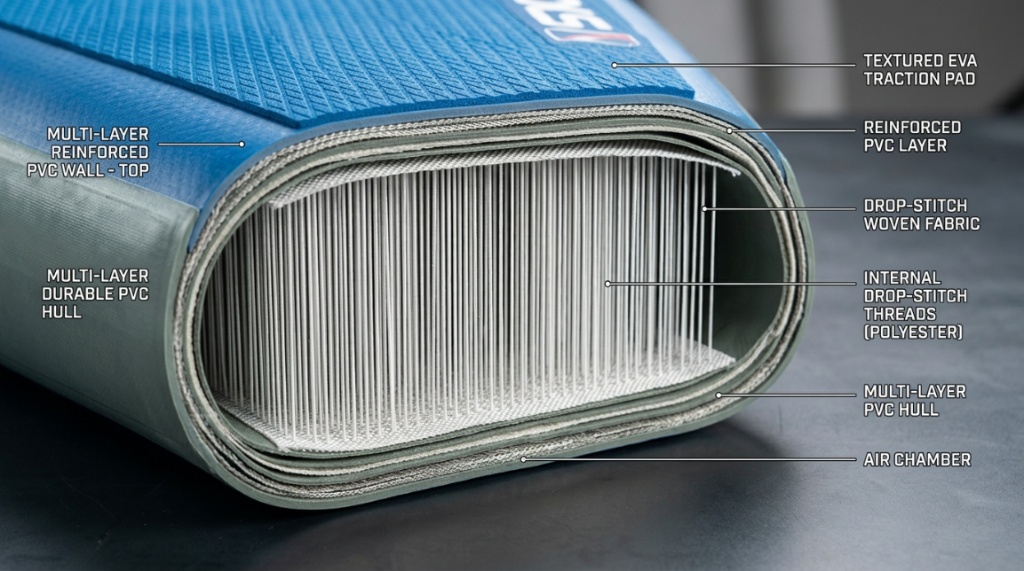
All inflatable boards use a drop-stitch construction. This involves thousands of polyester threads connecting the top and bottom layers of the board, which allows the board to take a rigid shape when inflated. The quality of the material and the number of layers define how stiff the board remains at high pressure.
- Single Layer (Standard): These boards are lighter and cheaper. However, they tend to feel “spongy” or flex underfoot, especially in cold water where the air inside contracts.
- Dual Layer or Woven: These boards feature an additional layer of PVC or a woven mesh. They are heavier but offer substantially better rigidity. They track straighter and feel almost like a hard board.
If you are willing to trade a little portability weight for performance, a dual-layer or fusion-construction board is a worthwhile investment. It also usually means the board will last longer without developing creases or punctures.
Type of Board: All-Around vs. Touring vs. Yoga
Inflatable paddle boards are not one-size-fits-all. Manufacturers design boards for specific use cases. Trying to use a racing board for yoga will result in an uncomfortable experience, and vice versa.
All-Around Boards
These are the “jack-of-all-trades” boards. They are usually between 10’ and 11’ long and 32” to 34” wide. They are stable, versatile, and capable of handling mild chop and flat water equally well. For most recreational paddlers, this is the category to start with. They are wide enough for beginners but fast enough for fitness paddling.
Touring Boards
Tourings are boards designed for speed and distance. They feature a longer, pointed nose (usually over 12′ long) that cuts through water efficiently. They tend to be narrower, requiring more balance skill. Choose a touring board if you intend to cover long distances or paddle multi-day excursions. They track straight, making them excellent for fitness paddling on open water.
Specialty Boards (Yoga & Fishing)
Yoga boards are exceptionally wide (34” to 36”) with a soft, cushioned deck pad that covers the entire top. This provides a stable platform for standing on one leg or moving around. Fishing boards are also wider and often include built-in rod holders and mounting points for coolers or crates. They prioritize stability above all else.
The Importance of Accessories and Kit Quality
Most inflatable paddle boards are sold as complete “kits.” These kits include the paddle, pump, leash, and a travel bag. Not all accessories are created equal. While the board itself is the most important part, a poor-quality paddle or pump can ruin your day.
The Pump: Manual vs. Electric
Manual pumps are standard in most kits. They are reliable and cheap. Look for a pump that is a “high-pressure” twin-chamber design. This allows you to inflate the board to 15 PSI without spending 30 minutes sweating on the beach. The pump is usually the first thing you should upgrade. An electric pump is a game-changer, allowing you to set a target PSI and walk away while it inflates the board automatically.
The Paddle: A Necessary Upgrade
Stock paddles are often aluminum with a plastic blade. They are heavy and can cause fatigue quickly. Padded areas on the shaft are a nice touch, but the weight matters most. While you can start with the included paddle, you will likely want to switch to a fiberglass or carbon-fiber paddle down the road. Those materials are lighter and transfer more of your energy into the water. If possible, allot extra budget to purchase a better paddle immediately.
Valve Types
Check the valve system. Most boards use a Halkey-Roberts valve (pushing and turning to open/close). It is quick to connect and disconnect hoses but has a smaller opening, which can make deflation slightly slower. Some premium boards use a larger military or Boston valve. Both work well; just ensure the board you buy comes with an adapter if you plan to use an electric pump later.
Avoiding Common First-Time Buyer Mistakes
Even with the right specifications in mind, beginners often overlook practical details that significantly impact longevity and use.
Mistake 1: Ignoring the Repairs Kit. You will get punctures; it is a matter of when, not if. Ensure your kit includes a patch kit and glue that matches the PVC material. Usually, the glue in the kit hardens after a year or so. Purchase new PVC-compatible glue each season.
Mistake 2: Storing It Rolled Up Tightly. If you store the board rolled tightly for a month, it will develop memory creases. These creases can weaken the PVC over time. Make sure the board is fully dry before storage, and if possible, store it partially inflated or flat.
Mistake 3: Not Checking the Warranty. Inflatable boards are a significant investment. Check the manufacturer’s warranty length. A company that offers a 2-year warranty usually stands behind their build quality better than one offering a 30-day return policy.
How to Match a Board to Your Weight and Height
There is a misconception that a taller person needs a longer board. Length relates more to speed and tracking than to supporting weight. Supporting weight is about width and volume. A tall, heavy paddler needs a wide, high-volume board regardless of their height. Consult the manufacturer’s weight recommendations specifically for volume, not length.
- Weigh yourself with the gear you plan to carry (water bottle, phone, dry bag).
- Find a board that has a maximum capacity at least 50 pounds greater than your combined weight.
- Cross-reference the width—anything 32 inches or wider is ideal if your combined weight approaches the board’s limit.
Select a board length that fits your intended use: under 10’ for surfing, 10’-11’ for all-around, and over 12’ for touring,
Price vs. Durability: Where to Focus Your Budget
Inflatable paddle boards typically range from $300 to over $1,500. The price difference correlates strongly with the construction and the quality of the accessories.
Budget boards (under $500) are usually made with single-layer PVC and have lower PSI ratings (maxing out at 10-12 PSI). They are okay for rental fleets or occasional use, but they will flex and may lose shape over time. Mid-range boards ($500-$900) offer dual-layer or fusion construction, better fins, and higher quality bags, hitting the sweet spot for most recreational paddlers. Premium boards ($1,000+) are lightweight, extremely rigid, and often include carbon paddles.
If you are on a budget, look for a mid-range board on sale rather than buying a cheap board that you will want to replace in a year. The rigidity of the board directly affects how efficient your paddle strokes are. A flexing board absorbs energy, making you work harder to travel the same distance,To explore foundational techniques and gear basics, check out this comprehensive Beginner’s Guide to Inflatable SUP Boards for Fun Water Sports.
Frequently Asked Questions
How long does an inflatable paddle board take to inflate?
Using a manual high-pressure pump, it takes approximately 10 to 15 minutes to reach the recommended 15 PSI. Using an electric pump reduces this time to about 5 to 8 minutes, depending on the board’s volume.
Can I leave my paddle board inflated all the time?
You can, but it is not ideal. Leaving it inflated in the sun or subject to temperature changes can alter the internal pressure, potentially straining the seams. It is best to deflate the board when not in use for extended periods to protect the drop-stitch threads and PVC material.
Is a solid board better than an inflatable?
Solid boards are usually faster and stiffer, but they are fragile and heavy. Inflatable boards are more durable against impacts, easier to transport, and now perform similarly to epoxy boards for leisure use. For most beginners and casual paddlers, the inflatable is the more practical choice.
How much PSI should I inflate my board to?
Most iSUP manufacturers recommend a pressure between 12 and 15 PSI. Inflating to the maximum recommended PSI is crucial. A board at 10 PSI will feel spongy and difficult to paddle. Always refer to the sticker printed on the board for the specific maximum rating.
Can you repair a puncture on an inflatable paddle board?
Yes. Most kits include a repair patch. For small punctures, clean the area, apply the supplied PVC glue, and press the patch firmly. For larger tears, it is recommended to use a repair kit with a special patch that fuses to the board fabric rather than just sticking to the surface.
Conclusion
Buying an inflatable paddle board is an exciting step toward countless days on the water. The key is to avoid rushing into a purchase based solely on aesthetics. Focus on the technical specifications—specifically volume, width, and construction—to ensure your board matches your size and skill level. Pay attention to the included accessories, as the pump and paddle will significantly impact your daily experience. Remember that rigidity and proper inflation are vital for performance. Whether you choose an all-around board for leisure paddling or a touring model for fitness, prioritizing quality construction over budget short-cuts will ensure your investment lasts and performs well for many seasons to come.