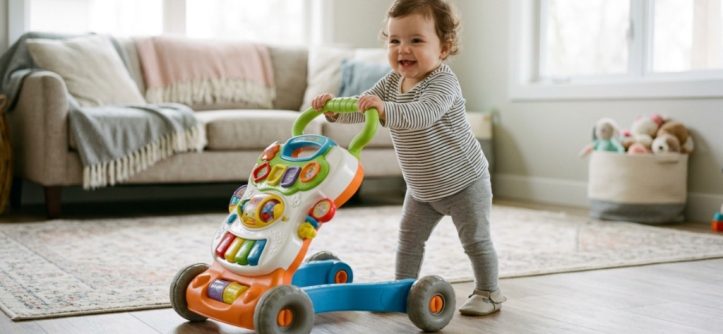
You spot your little one pulling up on the coffee table, bouncing with excitement, and you think: Maybe a baby walker will help them find their feet faster. But then you hear conflicting stories—some parents swear by them, while safety experts issue stern warnings. The truth is, selecting the right equipment is about balancing developmental support with rigorous safety standards. If you are confused about where to start, you are not alone.This guide cuts through the noise, helping you evaluate the best baby walkers baby walker safety features that actually matter, so your child can explore with confidence and you can rest easy.
What Makes a Baby Walker Safe for Infants?
A safe baby walker must have a wheelbase wider than the walker itself, a braking mechanism to stop at drop-offs like stairs, and a sturdy frame that does not tip when a child leans. Safety is not optional—it is non-negotiable. Look for models certified by the Juvenile Products Manufacturers Association (JPMA) and avoid walkers with X-frames, which are known to collapse. Always check that the seat fabric supports the baby upright without forcing their legs into an unnatural position.
Modern walkers also include interactive trays that lock in place and padding that prevents pinching. A common mistake parents make is choosing a walker that folds flat for storage; while convenient, poorly designed folding mechanisms can accidentally collapse with the baby inside. Stick to units with a one-piece, fixed base for maximum stability.
Which Safety Certifications Matter Most?
Look for the JPMA seal and compliance with ASTM F977-22 standards. These certifications mean the walker has passed tests for tip stability, stair entrapment, and structural integrity. Walkers without these marks may not meet minimum safety thresholds.
How Do Baby Walkers Actually Affect Walking Development?
Baby walkers can delay independent walking by up to three weeks because they encourage a different muscle movement pattern than natural crawling and cruising. The American Academy of Pediatrics strongly advises against traditional wheeled walkers for this reason. However, stationary activity centers and push-behind walkers (which the baby walks behind, not sits inside) can strengthen leg muscles and coordination without the risks. The key distinction is that a child should never sit in a walker and propel themselves with their toes—this builds the wrong muscles for walking.
If your goal is early walking success, favor push walkers or sit-to-stand toys that allow the baby to control the tempo. These tools mimic the natural standing and stepping motion babies do when holding furniture. You want equipment that practices walking, not one that suspends the baby in a seated position.
Which Type of Walker Promotes the Best Walking Milestones?
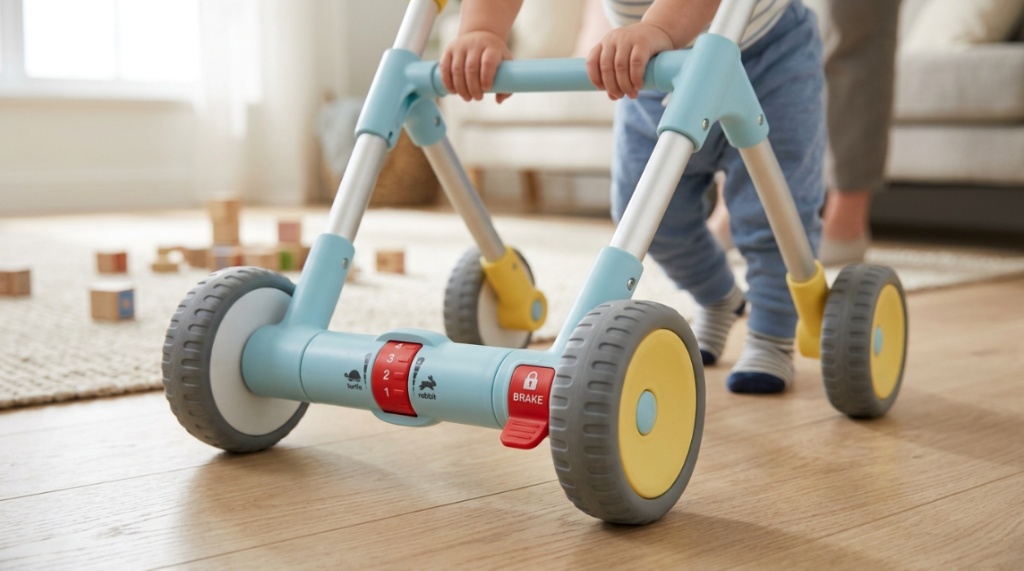
Push walkers with weight-adjustable wheels are the best choice for milestone development. Unlike sit-in models, push walkers let babies practice weight shifting and balance in a standing position. Choose a model with rubberized wheels that create resistance, so the toy does not roll away too fast. Adjustable speed settings are even better—start slow and gradually increase as your child gains leg strength. Stationary activity centers that rotate 360 degrees also allow safe standing practice without the mobility risks of traditional walkers.
Table: Sit-In vs. Push Baby Walkers
| Feature | Sit-In Walker | Push Walker |
|---|---|---|
| Walking delay risk | High (up to 3 weeks delay) | Low (mimics natural cruising) |
| Stair fall risk | High | Moderate (requires supervision) |
| Leg muscle development | Strengthens calves unevenly | Balanced leg and core engagement |
| Best for | Contained entertainment | Active walking practice |
What Key Features Should You Look for When Shopping?
Focus on four non-negotiables: an anti-tip base, a locking mechanism for folds, adjustable height settings, and a toy tray that can be removed for easy cleaning. The frame should feel heavy and solid when you lift it; lightweight plastic models often wobble. Check that the wheelbase extends past the baby’s center of gravity—not just the seat width. For electronic features, ensure buttons and music controls are secure and do not have small parts that could snap off. Velcro straps should be thick and difficult for curious fingers to unfasten. One often overlooked detail is floor compatibility: walkers with hard plastic wheels scratch hardwood, while foam wheels work well on most surfaces.
Can Baby Walkers Be Used Safely in Multi-Level Homes?
Yes, but only if you block all stairways with baby gates and never allow the walker near steps—even for a second. Fully 93 percent of baby walker injuries involve stairs, according to a 2022 study. If your home has an open floor plan with a sunken living room or split-level entry, avoid sit-in walkers entirely. Push walkers present a lower risk because the baby is standing and can stop themselves more naturally. Create a safe play zone by clearing low furniture, covering sharp corners, and removing rugs that could catch the wheels. Always stay within arm’s reach—walkers move fast, and a baby can travel across a room in seconds.
When Is the Right Age to Introduce a Baby Walker?
Wait until your baby can sit up unsupported and has good head control, typically between 6 and 8 months. Using a walker before this stage stresses immature hip and spine joints. Even at the correct age, limit sessions to 15–20 minutes at a time, no more than three times daily. Overuse encourages toe-walking and can make babies reluctant to crawl, a crucial step for core development. Watch for signs of fatigue like slumping or fussiness—end the session immediately. Ideally, only use a walker when you need a contained activity for a few minutes, not as a primary play station.
How Do You Properly Adjust and Maintain a Baby Walker?
Set the seat height so your baby’s feet rest flat on the floor with a slight bend at the knee—not pointed downward. If the baby is on tiptoes, lower the seat. If the seat is too low, the child leans forward, compressing their lower back. Check the wheel axles weekly for hair, dust, or carpet fibers that can lock the rollers. Wipe down the tray and frame with mild soap, avoiding harsh cleaners that taste bitter or leave residues. Inspect the braking mechanism monthly; many brakes rely on rubber pads that wear down after six months of regular use. Replace any walker that shows cracks, rust, or wobbly joints.
Why Are Stationary Activity Centers Often Recommended Instead?
Stationary activity centers (also called exersaucers) eliminate mobility risks entirely while still offering bouncing, spinning, and reaching play. They support the baby around the torso without allowing forward movement, so there is zero danger of a stair fall. Many pediatric occupational therapists prefer these because they encourage the same foot-flat standing posture needed for walking, without the harmful toe-pushing motion of wheeled walkers. Some models even convert into low tables for toddler use later. The trade-off is that stationary centers do not teach stepping—so pair them with crawling time and supervised cruising practice for complete development.
How Do You Choose Between Top Brands Without Getting Overwhelmed?
Filter brands by safety recall history first. The Consumer Product Safety Commission (CPSC) maintains a searchable database of recalled walkers—check it before buying, even for new models. Next, consider the presence of anti-tip wheels and stair sensors: top-tier brands like Fisher-Price and Joovy build these into their designs. Look at customer photographs in reviews, not just star ratings, to see how the walker holds up after months of use. Brands with easy-access replacement parts (like wheels and seat pads) are worth the extra cost because you can repair rather than replace. Avoid generic unbranded units sold on flash-sale sites; they rarely pass basic safety tests. For a consolidated list of models that combine durability with sound engineering, check out the curated selections on best baby walkers baby walker safety—it breaks down each option by real-world usage.
Can A Baby Walker Help a Pre-Walking Child Gain Confidence?
If used correctly, yes—but the confidence comes from controlled mobility, not the walker itself. A child who can safely move to reach a favorite toy may feel more independent. The trick is choosing a walker that allows gentle propulsion without speed. Push walkers with textured handles give babies something to grip, building hand-eye coordination alongside stepping. Over time, your child learns to stop by bumping into furniture or lowering to their knees, which develops spatial awareness. Just remember: the walker is a tool, not a substitute for the millions of steps they will take holding your hands or crawling across the living room floor. Confidence builds through effort, not shortcuts.
What Are the Hidden Dangers Most Parents Overlook?
Three hidden dangers frequently surprise parents: pinch points at the folding joint, chemical off-gassing from cheap plastics, and strangulation risks from loose strings or detachable toys. Before first use, run your fingers along every seam and hinge—any sharp edge or gap that could pinch a finger means the walker is unsafe. Unbox new walkers outside and let them air out for 24 hours to reduce volatile organic compounds (VOCs). Remove all dangling toys or ribbons that could wrap around a baby’s neck or wrist. Also, pay attention to the floor surface: walkers on tile can accelerate to dangerous speeds quickly, while thick carpet can cause the baby to tip forward when the wheels catch. Finally, never hang bags or purses from the walker tray; the added weight can throw off balance.
Summary Checklist for Buying Your Baby’s First Walker
- Certifications: JPMA seal and ASTM F977-22 compliance
- Base design: Wider wheelbase, no X-frame
- Brakes: Active stair sensors or grip pads
- Height adjustment: Multiple positions for growing babies
- Floor type: Match wheels to your home’s floors
- Age range: Minimum 6 months with strong sitting skills
- Usage limits: 15–20 minutes, three times a day maximum
- Cleaning: Removable, washable seat cover
- Recall history: Check CPSC database before buying
Frequently Asked Questions
Do baby walkers help babies walk sooner?
No. Studies show traditional sit-in walkers can delay independent walking by up to three weeks. Push walkers and stationary activity centers have a neutral or mildly positive effect on walking milestones.
Are wheeled baby walkers banned in any countries?
Yes. Canada banned the sale of wheeled baby walkers in 2004 due to high injury rates. The American Academy of Pediatrics also recommends against their use, though they remain legal in the United States.
What is the maximum weight limit for a typical baby walker?
Most walkers support up to 25–30 pounds (11–13 kilograms). Always check the manufacturer’s specifications; exceeding the limit risks structural failure.
Can a baby use a walker on carpet?
Thin, low-pile carpet works okay with foam wheels. High-pile or shag carpet grips the wheels and may cause the baby to tip forward. Hard floors are safer for wheeled walkers.
How often should I replace a baby walker?
Replace a walker any time you see cracks, broken wheels, or worn fabric. Secondhand walkers older than five years often lack modern safety features and should be avoided.
Is it safe to use a walker for a baby who cannot sit up yet?
No. Using a walker before the baby has independent sitting skills risks hip dysplasia and spinal stress. Wait until the child holds their head steady and sits without support.
What should I do if my baby’s walker is recalled?
Stop using it immediately. Register the recall with the manufacturer to receive a repair kit or refund. Do not pass recalled walkers to friends or donate them—dispose of them permanently.
Conclusion
Choosing a baby walker comes down to putting safety ahead of convenience and development ahead of entertainment. Stick to push walkers or stationary centers that respect your child’s natural progression from crawling to cruising. Check for rock-solid construction, certified safety features, and an age-appropriate height system that lets little feet rest flat. Remember that no piece of equipment replaces the value of tummy time, crawling, and hand-held walking practice with you. When you choose wisely, your walker becomes a short-term helper—not a crutch. Now that you know what to look for, take the checklist with you, compare models, and pick a winner that will help your baby take those first steps safely. Your little one is ready to move—make sure the ride is a safe one.
While an active push toy is incredible for building leg strength during the day, your little one will eventually need a safe place to rest and recharge. When they are ready for a break from on-the-floor mobility, checking out an Affordable Baby Swing Review can help you find a budget-friendly option to keep them relaxed.”