Car stereo amp draw matters more than most drivers realize because it directly affects how loud your system can play, how long your battery lasts, and whether you end up with flickering lights or a dead car in a parking lot. Understanding typical numbers and how to check your own car audio electrical load safely puts you in control of both sound quality and reliability.
What “car stereo amp draw” actually means
Car stereo amp draw is the amount of electrical current (in amps) your head unit and amplifiers pull from the vehicle’s 12–14.4 V electrical system while playing. Higher volume, more speakers, big subwoofers, and powerful external amplifiers all increase this current draw.
Amp draw is tied to power with a simple formula using Ohm’s Law: power P in watts is voltage V times current I in amps, so P=V×I. Because car systems typically run around 13.8 V with the engine on, a 276 W system would ideally draw about 20 A under full load, not counting efficiency losses.
Typical amp draw: stock vs upgraded
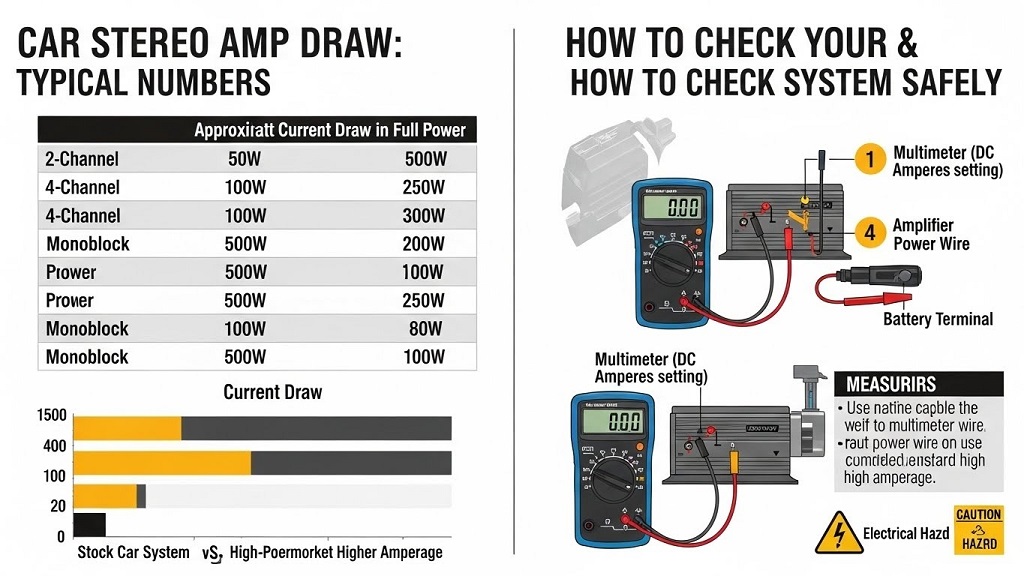
Most factory car stereos and modest aftermarket systems draw a relatively small amount of current compared to the starter motor, blower fan, or rear defroster. Things change quickly once you add dedicated amplifiers and high-power subwoofers.
Here is a practical view of average car stereo amps under real‑world use:
-
Basic factory or small aftermarket head unit only: roughly 0.5–2 A at idle/low volume and around 5–10 A at higher volume.
-
Aftermarket head unit with efficient internal amp, moderate speakers: often 5–15 A during lively listening.
-
System with one midsize amp (300–600 W RMS) plus head unit: total draw commonly in the 20–40 A range during loud playback peaks.
-
Large bass‑heavy setups (1000–2000 W+ RMS): peak draws can exceed 80–150 A or more, depending on amplifier efficiency and listening style.
Average listening draws far less than theoretical maximum because music is dynamic and not a continuous test tone, but you must size wiring, fuses, battery, and alternator for those peaks.
Typical head unit power usage
Because your blog focus includes “head unit power usage,” it helps to separate the head unit from the rest of the system. Most modern head units include a small internal amplifier and a display, Bluetooth module, tuner, and sometimes navigation or CarPlay/Android Auto.
Common figures for head unit draw:
-
Many modern units draw around 0.25–1.2 A just powered on at low volume, with single‑DIN units toward the low end and double‑DIN touchscreen units toward the higher end.
-
Under normal driving volume, average head unit power usage usually lands around 5–10 A, climbing toward 10–15 A when driving speakers directly at higher volume levels.
Because the head unit’s built‑in amp is relatively low power, most of the serious car audio electrical load in loud systems comes from external amplifiers, not the radio itself.
How much do external amps really draw?
Dedicated amplifiers transform your system from “okay” to “serious,” but they also drastically raise total amp draw. To estimate current draw from an amp, you combine the power formula with amplifier efficiency.
Many modern class D amps are 80%+ efficient, while older class AB designs may be closer to 50–65% under load. That efficiency matters because the amp must pull more power from the electrical system than it delivers to the speakers.
Example for estimating amp draw:
-
Suppose you have a 600 W RMS class D subwoofer amplifier.
-
At 80% efficiency, it needs about 600/0.8=750 W from the electrical system.
-
At 13.8 V running voltage, current draw is roughly 750/13.8≈54 A at full tilt.
You rarely hit full continuous power on music, but that gives a realistic upper‑bound for sizing wiring, fusing, and for understanding your car audio electrical load.
Quick reference table of typical amp draw
The table below pulls together “average car stereo amps” for common setups so readers can quickly gauge where they stand.
| System type | Typical amp draw while playing | Notes |
|---|---|---|
| Stock radio, no external amp | ~1–8 A total | Mostly head unit power usage at normal volume. |
| Aftermarket head unit only | ~5–15 A | Higher end when pushing built‑in amp hard. |
| Head unit + small 4‑ch amp (200–300 W RMS) | ~15–25 A | Good for upgraded door speakers, mild subs. |
| Head unit + 500–800 W RMS system | ~30–60 A | Common “daily driver” SQ or moderate SPL. |
| Head unit + 1000–2000 W+ RMS system | ~60–150+ A | Typically needs upgraded wiring, often extra battery or alternator. |
Why amp draw matters for your car
Ignoring car stereo amp draw can cause intermittent noise issues, dimming lights, or even leave you stranded with a discharged battery. Matching your audio setup to the electrical system is just as important as choosing speakers and subs.
Key risks of excessive car audio electrical load include:
-
Voltage drop: If your alternator cannot keep up, system voltage can fall below about 13.3 V while playing loud, often a sign the system is over‑drawing.
-
Battery strain: When alternator output is exceeded, the battery makes up the difference, shortening its life and raising the chance of no‑start situations.
-
Amplifier clipping and shutdown: Low voltage can cause amps to clip sooner or trigger under‑voltage protection, hurting sound quality and stressing components.
For most daily‑driven cars under about 1000 W RMS total, a healthy factory alternator and battery are usually adequate if wiring and grounds are done correctly.
How to estimate your own car stereo amp draw
Before reaching for a meter, you can build a solid estimate from your hardware and specs. This is often enough to know whether you are within safe limits or need upgrades.
-
List your components
-
Head unit RMS power (per channel × number of channels).
-
External amplifier RMS wattage at your wiring configuration (not “max” or “peak”).
-
-
Convert total power to electrical draw
-
For a modern class D sub amp, divide RMS watts by about 0.8 to account for efficiency.
-
For a class AB full‑range amp or internal head unit amp, dividing by 0.6 is a reasonable rule of thumb.
-
-
Divide by running voltage
-
Use 13.8 V as a realistic engine‑on voltage; divide total watts by 13.8 to get amps.
-
Sum the current from all amps plus an allowance (for example, 5–10 A) for the head unit, signal processors, and small accessories.
-
This method produces a “worst‑case” car audio electrical load for sizing power and ground wiring, fuses, and gauging alternator demand.
How to measure amp draw with tools (safely)
If you want hard numbers instead of estimates, you can measure car stereo amp draw directly, but safety comes first. Use a quality multimeter and, ideally, a DC amp clamp designed for automotive use.
Safe basic procedure:
-
Visual check first
-
Confirm fuses are correctly rated, power cables are undamaged, and grounds are tight and on clean metal.
-
Fix any obvious issues before stressing the system with tests.
-
-
Measure voltage at the battery
-
With engine off, a healthy battery is around 12.4–12.7 V at rest.
-
With engine idling and no audio load, voltage should typically read 13.5–14.4 V, indicating the alternator is charging properly.
-
-
Measure while playing
-
Turn the system up to a loud but realistic level and watch battery voltage.
-
If voltage drops below about 13.3 V and continues to sag when bass hits, your system is close to or beyond what the alternator can comfortably supply.
-
-
Check current with an amp clamp
-
Clamp around the main amplifier power cable and read the amps while playing music and during bass peaks.
-
Compare the reading with your wire gauge and fuse ratings to confirm the installation is within safe limits.
-
Never bypass fuses or “oversize” them just to prevent blowing; fuses are there to protect wiring and prevent fires.
Signs your system is overloading the electrical
You do not always need a meter to know something is wrong with car stereo amp draw; your car will tell you through clear symptoms. Pay attention to:
-
Headlights dimming or pulsing strongly with bass hits, especially at idle.
-
Dash lights flickering or infotainment resets when the music is loud.
-
Burning smells near wiring or amps, hot power cables, or repeatedly blown fuses.
Any of these signs indicate that the electrical system is stressed, wiring may be undersized, or there are ground and connection issues that must be corrected.
Ways to reduce or support amp draw
If your calculations or measurements show high car stereo amp draw, you have both “reduce demand” and “increase supply” options.
To reduce electrical demand:
-
Choose more efficient class D amplifiers instead of older, less efficient designs.
-
Set gains properly and avoid unnecessary bass boost or extreme equalizer settings that demand excessive power.
-
Use speakers and subs with reasonable impedance and sensitivity so you get more output per watt.
To support higher amp draw safely:
-
Upgrade “Big 3” wiring (battery positive to alternator, battery negative to chassis, engine block to chassis) with proper gauge cable.
-
Add a dedicated audio battery or high‑performance AGM/LiFePO₄ battery to buffer current peaks in large systems.
-
For systems above about 2000 W RMS, consider a high‑output alternator so the battery is not constantly discharging under load.
FAQs about car stereo amp draw
How many amps does a typical car stereo use?
A basic factory or small aftermarket stereo with no external amp usually uses somewhere in the 1–8 A range during normal listening, with short peaks a bit higher at loud moments. Systems with added amplifiers can easily push total draw into the 20–60 A range or more, depending on total RMS wattage.
Can my stereo drain the battery with the car off?
Yes, if you play the system with the engine off for long periods, the stereo can discharge the battery enough to prevent the engine from starting. Even small draws add up over hours because most automotive batteries are sized for short, high‑current cranking rather than deep‑cycle use.
Do I need a bigger alternator for my sound system?
Most daily systems under about 1000 W RMS can run on a healthy stock alternator with good wiring and grounds, though voltage may sag slightly at idle with heavy bass. For 2000 W RMS and above, many installers recommend a high‑output alternator to keep voltage stable and protect both audio gear and vehicle electronics.
Is a capacitor enough to fix dimming lights?
Capacitors can slightly smooth fast transients but do not actually generate power, so they cannot compensate for an undersized alternator or weak battery. In most cases, upgrading wiring, grounds, and charging capacity is more effective than adding a capacitor alone.
What wire size should I use for my amps?
Wire size should match maximum amp draw and run length, chosen according to accepted car audio wire gauge charts. For example, a run carrying 60–80 A over typical vehicle distances often uses 4‑gauge copper, while larger 150+ A systems may use 1/0‑gauge.
Conclusion
Understanding car stereo amp draw is the difference between a fun, reliable system and constant electrical headaches. Use the simple formulas and safe testing steps above to estimate or measure your own car audio electrical load, then decide whether you need wiring upgrades, a better battery, or a more efficient amp layout.
If you are planning a new build or worried about dimming lights and battery issues, now is the perfect time to audit your setup: list your wattage, calculate your draw, and inspect your wiring and grounds. Turn this knowledge into action by tuning gains correctly or scheduling a professional check‑up so your system stays loud, clean, and safe every time you hit play.
Related Topics: Diaphragm Carburetor Troubleshooting Guide: How to Fix Common Small Engine Problems
Related Topics: Quick Pasta Nights: Testing Affordable Extruders for Busy Cooks